Featured Events

All News

Old Foes, Old Friends

Scholars study the effects of pregnancy on hookworm infections in indigenous women in the Bolivian Amazon


Continue Reading Old Foes, Old Friends
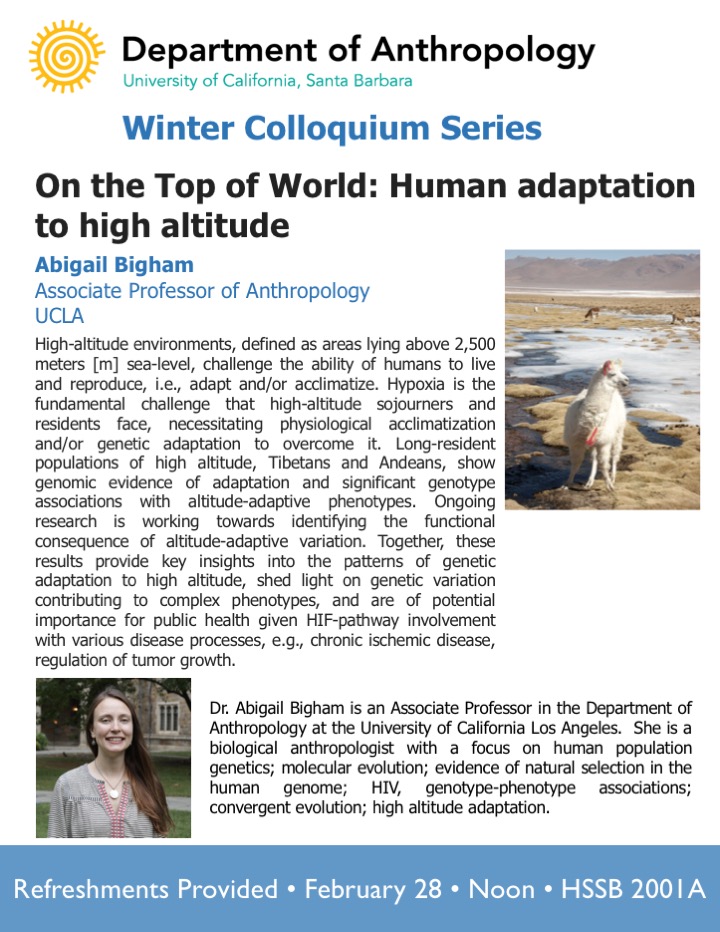

On Top of the World: Human adaptation to high altitude Event Image

On Top of the World: Human adaptation to high altitude

High-altitude environments, defined as areas lying above 2,500 meters [m] sea-level, challenge the ability of humans to live and reproduce, i.e., adapt and/or acclimatize. Hypoxia is the fundamental challenge that high-altitude sojourners and residents face, necessitating physiological acclimatization and/or genetic adaptation to overcome it. Long-resident populations of high altitude, Tibetans and Andeans, show genomic evidence of adaptation and significant genotype associations with altitude-adaptive phenotypes. Ongoing research is working towards identifying the functional consequence of altitude-adaptive variation. Together, these results provide key insights into the patterns of genetic adaptation to high altitude, shed light on genetic variation contributing to complex phenotypes, and are of potential importance for public health given HIF-pathway involvement with various disease processes, e.g., chronic ischemic disease, regulation of tumor growth.

Continue Reading On Top of the World: Human adaptation to high altitude


Indigenous Cooking Techniques

Grad student Emily Johnson develops method to identify key cooking process of indigenous communities in the archaeological record


Continue Reading Indigenous Cooking Techniques


The Evolution of Altruism: Michael Gurven

How the holidays bring out the better angels of our nature, according to evolutionary anthropology


Continue Reading The Evolution of Altruism: Michael Gurven


The Giving Season : Prof. Michael Gurven

How the holidays bring out the better angels of our nature, according to evolutionary anthropology


Continue Reading The Giving Season : Prof. Michael Gurven


UCSB Anthropology Lecturer Manasendu Kundu was ahead of the curve in linking human behavior and environmental consequences.

What do Manasendu (“Manny”) Kundu, UCSB Anthropology Ph.D. ‘94, and Al Gore have in common? The UCSB lecturer and the former US Vice President were both before their time in bringing to light an inconvenient truth about the impact of humans on the environment. 

Continue Reading UCSB Anthropology Lecturer Manasendu Kundu was ahead of the curve in linking human behavior and environmental consequences.


Agricultural Strategies and Environmental Change in the Ancient Eastern Mediterranean Event Image

Agricultural Strategies and Environmental Change in the Ancient Eastern Mediterranean

John M. Marston studies the long-term sustainability of agriculture and land use, with a focus on ancient societies of the Mediterranean and western and central Asia. His research focuses on how people make decisions about land use within changing economic, social, and environmental settings, and how those decisions affect the environment at local and regional scales. A specialist in paleoethnobotany, Marston’s contributions to the field include novel ways of linking ecological theory with archaeological methods to reconstruct agricultural and land-use strategies from plant and animal remains. Recent interdisciplinary collaborations focus on comparative study of cultural adaptation to environmental and climate change in the past and present; developing new methods to study the spatial distribution of land use from archaeological animal and plant remains; and the ecology of plague. His current field projects include work at multiple Bronze and Iron Age urban centers in Turkey (with ongoing fieldwork at Kerkenes and Gordion) and a multi-period site in Israel (Tel Shimron), as well as work in central Asia (Khorezm Ancient Agriculture Project, Uzbekistan).

Continue Reading Agricultural Strategies and Environmental Change in the Ancient Eastern Mediterranean


The Meaning of Life

Researchers, including Anthropology Professor Barbara Herr Harthorn, will gauge public perceptions of synthetic life.


Continue Reading The Meaning of Life